Levenshtein Distance
In information theory and computer science, the Levenshtein distance is a string metric for measuring the difference between two sequences. Informally, the Levenshtein distance between two words is the minimum number of single-character edits (insertion, deletion, substitution) required to change one word into the other. The phrase edit distance is often used to refer specifically to Levenshtein distance.
The Levenshtein distance between two strings is defined as the minimum number of edits needed to transform one string into the other, with the allowable edit operations being insertion, deletion, or substitution of a single character. It is named after Vladimir Levenshtein, who considered this distance in 1965. It is closely related to pairwise string alignments.
Definition
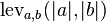
Mathematically, the Levenshtein distance between two strings  is given by
 where

Note that the first element in the minimum corresponds to deletion (from  to
 ), the second to insertion and the third to match or mismatch, depending on whether the respective symbols are the same.
Example
For example, the Levenshtein distance between "kitten" and "sitting" is 3, since the following three edits change one into the other, and there is no way to do it with fewer than three edits:
- kitten → sitten (substitution of "s" for "k")
- sitten → sittin (substitution of "i" for "e")
- sittin → sitting (insertion of "g" at the end).
Upper and lower bounds
The Levenshtein distance has several simple upper and lower bounds that are useful in applications which are applied with many of them and compare them. These include:
- It is always at least the difference of the sizes of the two strings.
- It is at most the length of the longer string.
- It is zero if and only if the strings are equal.
- If the strings are the same size, the Hamming distance is an upper bound on the Levenshtein distance.
- The Levenshtein distance between two strings is no greater than the sum of their Levenshtein distances from a third string (triangle inequality).
static int LevenshteinDistance(string s, string t)
{
    // degenerate cases
    if (s == t) return 0;
    if (s.Length == 0) return t.Length;
    if (t.Length == 0) return s.Length;

    // create two work vectors of integer distances
    int[] v0 = new int[t.Length + 1];
    int[] v1 = new int[t.Length + 1];

    // initialize v0 (the previous row of distances)
    // this row is A[0][i]: edit distance for an empty s
    // the distance is just the number of characters to delete from t
    for (int i = 0; i < v0.Length; i++)
        v0[i] = i;

    for (int i = 0; i < s.Length; i++)
    {
        // calculate v1 (current row distances) from the previous row v0

        // first element of v1 is A[i+1][0]
        //   edit distance is delete (i+1) chars from s to match empty t
        v1[0] = i + 1;

        // use formula to fill in the rest of the row
        for (int j = 0; j < t.Length; j++)
        {
            var cost = (s[i] == t[j]) ? 0 : 1;
            v1[j + 1] = Minimum(v1[j] + 1, v0[j + 1] + 1, v0[j] + cost);
        }

        // copy v1 (current row) to v0 (previous row) for next interation
        for (int j = 0; j < v0.Length; j++)
            v0[j] = v1[j];
    }

    return v1[t.Length];
}