Forward Dawg Matching
The Forward Dawg Matching algorithm computes the longest factor of the pattern ending at each position in the text. This is make possible by the use of the smallest suffix automaton (also called DAWG for Directed Acyclic Word Graph) of the pattern. The smallest suffix automaton of a word w is a Deterministic Finite Automaton S(w) = (Q, q0, T, E). The language accepted by S(w) isL(S(w))={u in  * : exists v in * such that w=vu}.
The preprocessing phase of the Forward Dawg Matching algorithm consists in computing the smallest suffix automaton for the pattern x. It is linear in time and space in the length of the pattern.
During the searching phase the Forward Dawg Matching algorithm parses the characters of the text from left to right with the automaton S(x) starting with state q0. For each state q in S(x) the longest path from q0 to p is denoted by length(q). This structure extensively uses the notion of suffix links. For each state p the suffix link of p is denoted by S[p]. For a state p, let Path(p)=(p0,p1, ... ,p ) be the suffix path of p such that p0=p, for 1
 i , pi=S[pi-1] and p=q0. For each text character y[j] sequentially, let p be the current state, then the Forward Dawg Matching algorithm takes a transition defined for y[j] for the first state of Path(p) for which such a transition is defined. The current state p is updated with the target state of this transition or with the initial state q0 if no transition exists labelled with y[j] from a state of Path(p).
An occurrence of x is found when length(p)=m.
The Forward Dawg Matching algorithm performs exactly n text character inspections.
Main features:
- uses the suffix automaton of x;
- O(n) worst case time complexity;
- performs exactly n text character inspections.
Example:
Preprocessing phase
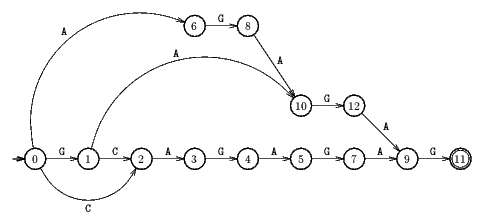
Suffix automaton used by Forward Dawg Matching Search algorithm.
Searching phase
| G | C | A | T | C | G | C | A | G | A | G | A | G | T | A | T | A | C | A | G | T | A | C | G |
| 1 | 2 | 3 | 0 |
| G | C | A | T | C | G | C | A | G | A | G | A | G | T | A | T | A | C | A | G | T | A | C | G |
| 2 | 0 |
| G | C | A | T | C | G | C | A | G | A | G | A | G | T | A | T | A | C | A | G | T | A | C | G |
| 1 | 2 | 3 | 4 | 5 | 7 | 9 | 1 | 0 | |||||||||||||||
| G | C | A | T | C | G | C | A | G | A | G | A | G | T | A | T | A | C | A | G | T | A | C | G |
| - | - | - | - | - | - | - | 1 |
| G | C | A | T | C | G | C | A | G | A | G | A | G | T | A | T | A | C | A | G | T | A | C | G |
| 6 | 0 |
| G | C | A | T | C | G | C | A | G | A | G | A | G | T | A | T | A | C | A | G | T | A | C | G |
| 6 | 2 | 3 | 4 | 0 |
| G | C | A | T | C | G | C | A | G | A | G | A | G | T | A | T | A | C | A | G | T | A | C | G |
| 6 | 2 | 1 |
The Forward Dawg Matching algorithm performs 24 character comparisons on the example.
struct _cell{
  int element;
  struct _cell *next;
};

typedef struct _cell *List;

struct _graph {
    int vertexNumber,
        edgeNumber,
        vertexCounter,
        initial,
        *terminal,
        *target,
        *suffixLink,
        *length,
        *position,
        *shift;
  };

  typedef struct _graph *Graph;
  typedef int boolean;

#define UNDEFINED -1

/* returns a new data structure for
   a graph with v vertices and e edges */
Graph newGraph(int v, int e) {
   Graph g;

   g = (Graph)calloc(1, sizeof(struct _graph));
   if (g == NULL)
      error("newGraph");
   g->vertexNumber  = v;
   g->edgeNumber    = e;
   g->initial       = 0;
   g->vertexCounter = 1;
   return(g);
}


/* returns a new data structure for
   a automaton with v vertices and e edges */
Graph newAutomaton(int v, int e) {
   Graph aut;

   aut = newGraph(v, e);
   aut->target = (int *)calloc(e, sizeof(int));
   if (aut->target == NULL)
      error("newAutomaton");
   aut->terminal = (int *)calloc(v, sizeof(int));
   if (aut->terminal == NULL)
      error("newAutomaton");
   return(aut);
}


/* returns a new data structure for
   a suffix automaton with v vertices and e edges */
Graph newSuffixAutomaton(int v, int e) {
   Graph aut;

   aut = newAutomaton(v, e);
   memset(aut->target, UNDEFINED, e*sizeof(int));
   aut->suffixLink = (int *)calloc(v, sizeof(int));
   if (aut->suffixLink == NULL)
      error("newSuffixAutomaton");
   aut->length = (int *)calloc(v, sizeof(int));
   if (aut->length == NULL)
      error("newSuffixAutomaton");
   aut->position = (int *)calloc(v, sizeof(int));
   if (aut->position == NULL)
      error("newSuffixAutomaton");
   aut->shift = (int *)calloc(e, sizeof(int));
   if (aut->shift == NULL)
      error("newSuffixAutomaton");
   return(aut);
}


/* returns a new data structure for
   a trie with v vertices and e edges */
Graph newTrie(int v, int e) {
   Graph aut;

   aut = newAutomaton(v, e);
   memset(aut->target, UNDEFINED, e*sizeof(int));
   aut->suffixLink = (int *)calloc(v, sizeof(int));
   if (aut->suffixLink == NULL)
      error("newTrie");
   aut->length = (int *)calloc(v, sizeof(int));
   if (aut->length == NULL)
      error("newTrie");
   aut->position = (int *)calloc(v, sizeof(int));
   if (aut->position == NULL)
      error("newTrie");
   aut->shift = (int *)calloc(e, sizeof(int));
   if (aut->shift == NULL)
      error("newTrie");
   return(aut);
}


/* returns a new vertex for graph g */
int newVertex(Graph g) {
   if (g != NULL && g->vertexCounter <= g->vertexNumber)
      return(g->vertexCounter++);
   error("newVertex");
}


/* returns the initial vertex of graph g */
int getInitial(Graph g) {
   if (g != NULL)
      return(g->initial);
   error("getInitial");
}


/* returns true if vertex v is terminal in graph g */
boolean isTerminal(Graph g, int v) {
   if (g != NULL && g->terminal != NULL &&
       v < g->vertexNumber)
      return(g->terminal[v]);
   error("isTerminal");
}


/* set vertex v to be terminal in graph g */
void setTerminal(Graph g, int v) {
   if (g != NULL && g->terminal != NULL &&
       v < g->vertexNumber)
      g->terminal[v] = 1;
   else
      error("isTerminal");
}


/* returns the target of edge from vertex v
   labelled by character c in graph g */
int getTarget(Graph g, int v, unsigned char c) {
   if (g != NULL && g->target != NULL &&
       v < g->vertexNumber && v*c < g->edgeNumber)
      return(g->target[v*(g->edgeNumber/g->vertexNumber) +
                       c]);
   error("getTarget");
}


/* add the edge from vertex v to vertex t
   labelled by character c in graph g */
void setTarget(Graph g, int v, unsigned char c, int t) {
   if (g != NULL && g->target != NULL &&
       v < g->vertexNumber &&
       v*c <= g->edgeNumber && t < g->vertexNumber)
      g->target[v*(g->edgeNumber/g->vertexNumber) + c] = t;
   else
      error("setTarget");
}


/* returns the suffix link of vertex v in graph g */
int getSuffixLink(Graph g, int v) {
   if (g != NULL && g->suffixLink != NULL &&
       v < g->vertexNumber)
      return(g->suffixLink[v]);
   error("getSuffixLink");
}


/* set the suffix link of vertex v
   to vertex s in graph g */
void setSuffixLink(Graph g, int v, int s) {
   if (g != NULL && g->suffixLink != NULL &&
       v < g->vertexNumber && s < g->vertexNumber)
      g->suffixLink[v] = s;
   else
      error("setSuffixLink");
}


/* returns the length of vertex v in graph g */
int getLength(Graph g, int v) {
   if (g != NULL && g->length != NULL &&
       v < g->vertexNumber)
      return(g->length[v]);
   error("getLength");
}


/* set the length of vertex v to integer ell in graph g */
void setLength(Graph g, int v, int ell) {
   if (g != NULL && g->length != NULL &&
       v < g->vertexNumber)
      g->length[v] = ell;
   else
      error("setLength");
}


/* returns the position of vertex v in graph g */
int getPosition(Graph g, int v) {
   if (g != NULL && g->position != NULL &&
       v < g->vertexNumber)
      return(g->position[v]);
   error("getPosition");
}


/* set the length of vertex v to integer ell in graph g */
void setPosition(Graph g, int v, int p) {
   if (g != NULL && g->position != NULL &&
       v < g->vertexNumber)
      g->position[v] = p;
   else
      error("setPosition");
}


/* returns the shift of the edge from vertex v
   labelled by character c in graph g */
int getShift(Graph g, int v, unsigned char c) {
   if (g != NULL && g->shift != NULL &&
       v < g->vertexNumber && v*c < g->edgeNumber)
      return(g->shift[v*(g->edgeNumber/g->vertexNumber) +
             c]);
   error("getShift");
}


/* set the shift of the edge from vertex v
   labelled by character c to integer s in graph g */
void setShift(Graph g, int v, unsigned char c, int s) {
   if (g != NULL && g->shift != NULL &&
       v < g->vertexNumber && v*c <= g->edgeNumber)
      g->shift[v*(g->edgeNumber/g->vertexNumber) + c] = s;
   else
      error("setShift");
}


/* copies all the characteristics of vertex source
   to vertex target in graph g */
void copyVertex(Graph g, int target, int source) {
   if (g != NULL && target < g->vertexNumber &&
       source < g->vertexNumber) {
      if (g->target != NULL)
         memcpy(g->target +
                target*(g->edgeNumber/g->vertexNumber),
                g->target +
                source*(g->edgeNumber/g->vertexNumber),
                (g->edgeNumber/g->vertexNumber)*
                sizeof(int));
      if (g->shift != NULL)
         memcpy(g->shift +
                target*(g->edgeNumber/g->vertexNumber),
                g->shift +
                source*(g->edgeNumber/g->vertexNumber),
                g->edgeNumber/g->vertexNumber)*
                sizeof(int));
      if (g->terminal != NULL)
         g->terminal[target] = g->terminal[source];
      if (g->suffixLink != NULL)
         g->suffixLink[target] = g->suffixLink[source];
      if (g->length != NULL)
         g->length[target] = g->length[source];
      if (g->position != NULL)
         g->position[target] = g->position[source];
   }
   else
      error("copyVertex");
}

void buildSuffixAutomaton(char *x, int m, Graph aut) {
   int i, art, init, last, p, q, r;
   char c;

   init = getInitial(aut);
   art = newVertex(aut);
   setSuffixLink(aut, init, art);
   last = init;
   for (i = 0; i < m; ++i) {
      c = x[i];
      p = last;
      q = newVertex(aut);
      setLength(aut, q, getLength(aut, p) + 1);
      setPosition(aut, q, getPosition(aut, p) + 1);
      while (p != init &&
             getTarget(aut, p, c) == UNDEFINED) {
         setTarget(aut, p, c, q);
         setShift(aut, p, c, getPosition(aut, q) -
                             getPosition(aut, p) - 1);
         p = getSuffixLink(aut, p);
      }
      if (getTarget(aut, p, c) == UNDEFINED) {
         setTarget(aut, init, c, q);
         setShift(aut, init, c,
                  getPosition(aut, q) -
                  getPosition(aut, init) - 1);
         setSuffixLink(aut, q, init);
      }
      else
         if (getLength(aut, p) + 1 ==
             getLength(aut, getTarget(aut, p, c)))
            setSuffixLink(aut, q, getTarget(aut, p, c));
         else {
            r = newVertex(aut);
            copyVertex(aut, r, getTarget(aut, p, c));
            setLength(aut, r, getLength(aut, p) + 1);
            setSuffixLink(aut, getTarget(aut, p, c), r);
            setSuffixLink(aut, q, r);
            while (p != art &&
                   getLength(aut, getTarget(aut, p, c)) >=
                   getLength(aut, r)) {
               setShift(aut, p, c,
                        getPosition(aut,
                                    getTarget(aut, p, c)) -
                        getPosition(aut, p) - 1);
               setTarget(aut, p, c, r);
               p = getSuffixLink(aut, p);
            }
         }
      last = q;
   }
   setTerminal(aut, last);
   while (last != init) {
      last = getSuffixLink(aut, last);
      setTerminal(aut, last);
   }
}

int FDM(char *x, int m, char *y, int n) {
   int j, init, ell, state;
   Graph aut;

   /* Preprocessing */
   aut = newSuffixAutomaton(2*(m + 2), 2*(m + 2)*ASIZE);
   buildSuffixAutomaton(x, m, aut);
   init = getInitial(aut);

   /* Searching */
   ell = 0;
   state = init;
   for (j = 0; j < n; ++j) {
      if (getTarget(aut, state, y[j]) != UNDEFINED) {
         ++ell;
         state = getTarget(aut, state, y[j]);
      }
      else {
         while (state != init &&
                getTarget(aut, state, y[j]) == UNDEFINED)
            state = getSuffixLink(aut, state);
         if (getTarget(aut, state, y[j]) != UNDEFINED) {
            ell = getLength(aut, state) + 1;
            state = getTarget(aut, state, y[j]);
         }
         else {
            ell = 0;
            state = init;
         }
      }
      if (ell == m)
         OUTPUT(j - m + 1);
   }
}