Turbo Reverse
It is possible to make the Reverse Factor algorithm linear. It is in fact enough to remember the prefix u of x matched during the last attempt. Then during the current attempt when reaching the right end of u, it is easy to show that it is sufficient to read again at most the rightmost half of u. This is made by the Turbo Reverse Factor algorithm.
If a word z is a factor of a word w we define disp(z,w) the displacement of z in w to be the least integer d>0 such that w[m-d-|z|-1 .. m-d]=z.
The general situation of the Turbo Reverse Factor algorithm is when a prefix u is found in the text during the last attempt and for the current attempt the algorithm tries to match the factor v of length m-|u| in the text immediately at the right of u. If v is not a factor of x then the shift is computed as in the Reverse Factor algorithm. If v is a suffix of x then an occurrence of x has been found. If v is not a suffix but a factor of x then it is sufficient to scan again the min(per(u),|u|/2) rightmost characters of u. If u is periodic (i.e. per(u)  |u|/2) let z be the suffix of u of length per(u). By definition of the period z is an acyclic word and then an overlap such as shown in Figure 23.1 is impossible.
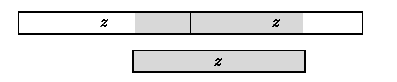
Figure 23.1: Impossible overlap if z is an acyclic word.
Thus z can only occur in u at distances multiple of per(u) which implies that the smallest proper suffix of uv which is a prefix of x has a length equal to |uv|-disp(zv,x)=m-disp(zv,x). Thus the length of the shift to perform is disp(zv,x).
If u is not periodic (per(u)>|u|/2), it is obvious that x can not reoccur in the left part of u of length per(u). It is then sufficient to scan the right part of u of length |u|-per(u) < |u|/2 to find a non defined transition in the automaton.
The function disp is implemented directly in the automaton S(x) without changing the complexity of its construction.
The preprocessing phase consists in building the suffix automaton of xR. It can be done in O(m) time complexity.
The searching phase is in O(n) time complexity. The Turbo Reverse Factor performs at most 2n inspections of text characters and it is also optimal in average performing O( n.log (m) / m )inspections of text characters on the average reaching the best bound shown by Yao in 1979.
Main features:
- refinement of the Reverse Factor algorithm;
- preprocessing phase in O(m) time and space complexity;
- searching phase in O(n) time complexity;
- performs 2n text characters inspections in the worst case;
- optimal in the average.
Example:
Preprocessing phase

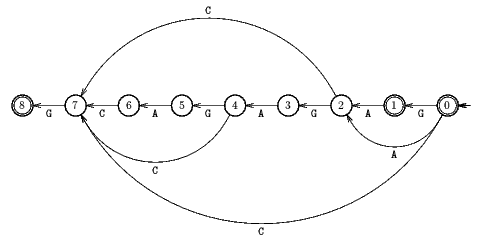
Suffix automaton used by Turbo Reverse Factor algorithm.
Searching phase
| G | C | A | T | C | G | C | A | G | A | G | A | G | T | A | T | A | C | A | G | T | A | C | G |
| * | 8 | 7 | 2 | ||||||||||||||||||||
| G | C | A | G | A | G | A | G |
Shift by: 5 (8 - 3)
| G | C | A | T | C | G | C | A | G | A | G | A | G | T | A | T | A | C | A | G | T | A | C | G |
| - | - | - | 5 | 4 | 3 | 2 | 1 | ||||||||||||||||
| G | C | A | G | A | G | A | G |
Shift by: 7 (8 - 1)
| G | C | A | T | C | G | C | A | G | A | G | A | G | T | A | T | A | C | A | G | T | A | C | G |
| * | 7 | 2 | 1 | ||||||||||||||||||||
| G | C | A | G | A | G | A | G |
Shift by: 7 (8 - 1)
The Turbo Reverse Factor algorithm performs 13 character comparisons on the example.
 struct _cell{
    int element;
    struct _cell *next;
  };

  typedef struct _cell *List;

  struct _graph {
    int vertexNumber,
        edgeNumber,
        vertexCounter,
        initial,
        *terminal,
        *target,
        *suffixLink,
        *length,
        *position,
        *shift;
  };

  typedef struct _graph *Graph;
  typedef int boolean;

#define UNDEFINED -1

/* returns a new data structure for
   a graph with v vertices and e edges */
Graph newGraph(int v, int e) {
   Graph g;

   g = (Graph)calloc(1, sizeof(struct _graph));
   if (g == NULL)
      error("newGraph");
   g->vertexNumber  = v;
   g->edgeNumber    = e;
   g->initial       = 0;
   g->vertexCounter = 1;
   return(g);
}


/* returns a new data structure for
   a automaton with v vertices and e edges */
Graph newAutomaton(int v, int e) {
   Graph aut;

   aut = newGraph(v, e);
   aut->target = (int *)calloc(e, sizeof(int));
   if (aut->target == NULL)
      error("newAutomaton");
   aut->terminal = (int *)calloc(v, sizeof(int));
   if (aut->terminal == NULL)
      error("newAutomaton");
   return(aut);
}


/* returns a new data structure for
   a suffix automaton with v vertices and e edges */
Graph newSuffixAutomaton(int v, int e) {
   Graph aut;

   aut = newAutomaton(v, e);
   memset(aut->target, UNDEFINED, e*sizeof(int));
   aut->suffixLink = (int *)calloc(v, sizeof(int));
   if (aut->suffixLink == NULL)
      error("newSuffixAutomaton");
   aut->length = (int *)calloc(v, sizeof(int));
   if (aut->length == NULL)
      error("newSuffixAutomaton");
   aut->position = (int *)calloc(v, sizeof(int));
   if (aut->position == NULL)
      error("newSuffixAutomaton");
   aut->shift = (int *)calloc(e, sizeof(int));
   if (aut->shift == NULL)
      error("newSuffixAutomaton");
   return(aut);
}


/* returns a new data structure for
   a trie with v vertices and e edges */
Graph newTrie(int v, int e) {
   Graph aut;

   aut = newAutomaton(v, e);
   memset(aut->target, UNDEFINED, e*sizeof(int));
   aut->suffixLink = (int *)calloc(v, sizeof(int));
   if (aut->suffixLink == NULL)
      error("newTrie");
   aut->length = (int *)calloc(v, sizeof(int));
   if (aut->length == NULL)
      error("newTrie");
   aut->position = (int *)calloc(v, sizeof(int));
   if (aut->position == NULL)
      error("newTrie");
   aut->shift = (int *)calloc(e, sizeof(int));
   if (aut->shift == NULL)
      error("newTrie");
   return(aut);
}


/* returns a new vertex for graph g */
int newVertex(Graph g) {
   if (g != NULL && g->vertexCounter <= g->vertexNumber)
      return(g->vertexCounter++);
   error("newVertex");
}


/* returns the initial vertex of graph g */
int getInitial(Graph g) {
   if (g != NULL)
      return(g->initial);
   error("getInitial");
}


/* returns true if vertex v is terminal in graph g */
boolean isTerminal(Graph g, int v) {
   if (g != NULL && g->terminal != NULL &&
       v < g->vertexNumber)
      return(g->terminal[v]);
   error("isTerminal");
}


/* set vertex v to be terminal in graph g */
void setTerminal(Graph g, int v) {
   if (g != NULL && g->terminal != NULL &&
       v < g->vertexNumber)
      g->terminal[v] = 1;
   else
      error("isTerminal");
}


/* returns the target of edge from vertex v
   labelled by character c in graph g */
int getTarget(Graph g, int v, unsigned char c) {
   if (g != NULL && g->target != NULL &&
       v < g->vertexNumber && v*c < g->edgeNumber)
      return(g->target[v*(g->edgeNumber/g->vertexNumber) +
                       c]);
   error("getTarget");
}


/* add the edge from vertex v to vertex t
   labelled by character c in graph g */
void setTarget(Graph g, int v, unsigned char c, int t) {
   if (g != NULL && g->target != NULL &&
       v < g->vertexNumber &&
       v*c <= g->edgeNumber && t < g->vertexNumber)
      g->target[v*(g->edgeNumber/g->vertexNumber) + c] = t;
   else
      error("setTarget");
}


/* returns the suffix link of vertex v in graph g */
int getSuffixLink(Graph g, int v) {
   if (g != NULL && g->suffixLink != NULL &&
       v < g->vertexNumber)
      return(g->suffixLink[v]);
   error("getSuffixLink");
}


/* set the suffix link of vertex v
   to vertex s in graph g */
void setSuffixLink(Graph g, int v, int s) {
   if (g != NULL && g->suffixLink != NULL &&
       v < g->vertexNumber && s < g->vertexNumber)
      g->suffixLink[v] = s;
   else
      error("setSuffixLink");
}


/* returns the length of vertex v in graph g */
int getLength(Graph g, int v) {
   if (g != NULL && g->length != NULL &&
       v < g->vertexNumber)
      return(g->length[v]);
   error("getLength");
}


/* set the length of vertex v to integer ell in graph g */
void setLength(Graph g, int v, int ell) {
   if (g != NULL && g->length != NULL &&
       v < g->vertexNumber)
      g->length[v] = ell;
   else
      error("setLength");
}


/* returns the position of vertex v in graph g */
int getPosition(Graph g, int v) {
   if (g != NULL && g->position != NULL &&
       v < g->vertexNumber)
      return(g->position[v]);
   error("getPosition");
}


/* set the length of vertex v to integer ell in graph g */
void setPosition(Graph g, int v, int p) {
   if (g != NULL && g->position != NULL &&
       v < g->vertexNumber)
      g->position[v] = p;
   else
      error("setPosition");
}


/* returns the shift of the edge from vertex v
   labelled by character c in graph g */
int getShift(Graph g, int v, unsigned char c) {
   if (g != NULL && g->shift != NULL &&
       v < g->vertexNumber && v*c < g->edgeNumber)
      return(g->shift[v*(g->edgeNumber/g->vertexNumber) +
             c]);
   error("getShift");
}


/* set the shift of the edge from vertex v
   labelled by character c to integer s in graph g */
void setShift(Graph g, int v, unsigned char c, int s) {
   if (g != NULL && g->shift != NULL &&
       v < g->vertexNumber && v*c <= g->edgeNumber)
      g->shift[v*(g->edgeNumber/g->vertexNumber) + c] = s;
   else
      error("setShift");
}


/* copies all the characteristics of vertex source
   to vertex target in graph g */
void copyVertex(Graph g, int target, int source) {
   if (g != NULL && target < g->vertexNumber &&
       source < g->vertexNumber) {
      if (g->target != NULL)
         memcpy(g->target +
                target*(g->edgeNumber/g->vertexNumber),
                g->target +
                source*(g->edgeNumber/g->vertexNumber),
                (g->edgeNumber/g->vertexNumber)*
                sizeof(int));
      if (g->shift != NULL)
         memcpy(g->shift +
                target*(g->edgeNumber/g->vertexNumber),
                g->shift +
                source*(g->edgeNumber/g->vertexNumber),
                g->edgeNumber/g->vertexNumber)*
                sizeof(int));
      if (g->terminal != NULL)
         g->terminal[target] = g->terminal[source];
      if (g->suffixLink != NULL)
         g->suffixLink[target] = g->suffixLink[source];
      if (g->length != NULL)
         g->length[target] = g->length[source];
      if (g->position != NULL)
         g->position[target] = g->position[source];
   }
   else
      error("copyVertex");
}

void preMp(char *x, int m, int mpNext[]) {
   int i, j;

   i = 0;
   j = mpNext[0] = -1;
   while (i < m) {
      while (j > -1 && x[i] != x[j])
         j = mpNext[j];
      mpNext[++i] = ++j;
   }
}

void buildSuffixAutomaton(char *x, int m, Graph aut) {
   int i, art, init, last, p, q, r;
   char c;

   init = getInitial(aut);
   art = newVertex(aut);
   setSuffixLink(aut, init, art);
   last = init;
   for (i = 0; i < m; ++i) {
      c = x[i];
      p = last;
      q = newVertex(aut);
      setLength(aut, q, getLength(aut, p) + 1);
      setPosition(aut, q, getPosition(aut, p) + 1);
      while (p != init &&
             getTarget(aut, p, c) == UNDEFINED) {
         setTarget(aut, p, c, q);
         setShift(aut, p, c, getPosition(aut, q) -
                             getPosition(aut, p) - 1);
         p = getSuffixLink(aut, p);
      }
      if (getTarget(aut, p, c) == UNDEFINED) {
         setTarget(aut, init, c, q);
         setShift(aut, init, c,
                  getPosition(aut, q) -
                  getPosition(aut, init) - 1);
         setSuffixLink(aut, q, init);
      }
      else
         if (getLength(aut, p) + 1 ==
             getLength(aut, getTarget(aut, p, c)))
            setSuffixLink(aut, q, getTarget(aut, p, c));
         else {
            r = newVertex(aut);
            copyVertex(aut, r, getTarget(aut, p, c));
            setLength(aut, r, getLength(aut, p) + 1);
            setSuffixLink(aut, getTarget(aut, p, c), r);
            setSuffixLink(aut, q, r);
            while (p != art &&
                   getLength(aut, getTarget(aut, p, c)) >=
                   getLength(aut, r)) {
               setShift(aut, p, c,
                        getPosition(aut,
                                    getTarget(aut, p, c)) -
                        getPosition(aut, p) - 1);
               setTarget(aut, p, c, r);
               p = getSuffixLink(aut, p);
            }
         }
      last = q;
   }
   setTerminal(aut, last);
   while (last != init) {
      last = getSuffixLink(aut, last);
      setTerminal(aut, last);
   }
}

char *reverse(char *x, int m) {
   char *xR;
   int i;

   xR = (char *)malloc((m + 1)*sizeof(char));
   for (i = 0; i < m; ++i)
      xR[i] = x[m - 1 - i];
   xR[m] = '\0';
   return(xR);
}

void TRF(char *x, int m, char *y, int n) {
   int period, i, j, shift, u, periodOfU, disp, init,
       state, mu, mpNext[XSIZE + 1];
   char *xR;
   Graph aut;

   /* Preprocessing */
   aut = newSuffixAutomaton(2*(m + 2), 2*(m + 2)*ASIZE);
   xR = reverse(x, m);
   buildSuffixAutomaton(xR, m, aut);
   init = getInitial(aut);
   preMp(x, m, mpNext);
   period = m - mpNext[m];
   i = 0;
   shift = m;

   /* Searching */
   j = 0;
   while (j <= n - m) {
      i = m - 1;
      state = init;
      u = m - 1 - shift;
      periodOfU = (shift != m ?
                   m - shift - mpNext[m - shift] : 0);
      shift = m;
      disp = 0;
      while (i > u &&
             getTarget(aut, state, y[i + j]) !=
             UNDEFINED) {
         disp += getShift(aut, state, y[i + j]);
         state = getTarget(aut, state, y[i + j]);
         if (isTerminal(aut, state))
            shift = i;
         --i;
      }
      if (i <= u)
         if (disp == 0) {
            OUTPUT(j);
            shift = period;
         }
         else {
            mu = (u + 1)/2;
            if (periodOfU <= mu) {
               u -= periodOfU;
               while (i > u &&
                      getTarget(aut, state, y[i + j]) !=
                      UNDEFINED) {
                  disp += getShift(aut, state, y[i + j]);
                  state = getTarget(aut, state, y[i + j]);
                  if (isTerminal(aut, state))
                     shift = i;
                  --i;
               }
               if (i <= u)
                  shift = disp;
            }
            else {
               u = u - mu - 1;
               while (i > u &&
                      getTarget(aut, state, y[i + j]) !=
                      UNDEFINED) {
                  disp += getShift(aut, state, y[i + j]);
                  state = getTarget(aut, state, y[i + j]);
                  if (isTerminal(aut, state))
                     shift = i;
                  --i;
               }
            }
         }
      j += shift;
   }
}